
What’s holding back infrastructure delivery in growth area councils?

I’ve been exploring how contribution systems are working in practice across growth area councils in Melbourne.
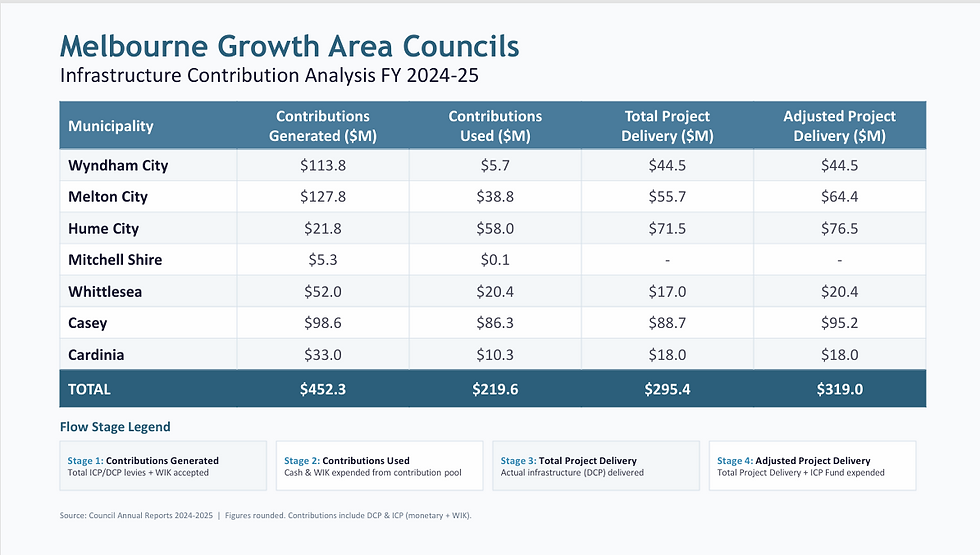
When looking at Melton as a case study in 2024–25 alone:
Total contributions reached $127.8M
Works-in-kind (WIK) formed a significant share (~$78.5M)
Monetary contributions were also substantial (~$49M)

On the surface, this suggests a system that is relatively well funded.But when looking at how this translates into delivery:
Around $38.8M of DCP/ICP funds were expended
Total project delivery expenditure for DCP + ICP contribution projects were ~$64.4M, with additional Council and external funding required
What seems to sit behind this is the nature of works-in-kind. A significant portion reflects:
land acquisition
early-stage or enabling inputs rather than completed, usable infrastructure.
This creates a lag between contributions being recognised and outcomes being realised on the ground. Even with relatively high reserves (e.g. $2.28B for Melton in 24-25), the constraint does not appear to be funding availability alone, but how and when available funds, along with contributions are brought into delivery. At the same time, Melton is actively led growth area councils in new capital asset expenditure in 24-25 (~$106M), ahead of Whittlesea and Wyndham (~$70M).
What this suggests is not a funding gap, but a systems challenge.
Councils have strong contribution inflows and active delivery programs. The complexity lies in how different forms of contributions (cash, land and works) are timed, controlled and integrated into delivery pathways.
This points toward the importance of capital delivery frameworks that can better align funding, sequencing and infrastructure provision in practice.
It also reinforces that strategic urban planning today is as much about delivery as it is about vision so that infrastructure keeps pace with growth in practice and not just in plans.
